Packaging & Supplies
The Best Industrial Packaging Solutions for Fragile Items
9
min read
November 27, 2025
Protect fragile items during shipping with the right industrial packaging. Learn how to reduce damage, lower costs, and choose the right materials for your fulfillment operation. Expert tips included.
Shipping fragile items safely is one of the most significant and challenging tasks in industrial logistics. Whether you’re shipping glassware, electronics, laboratory equipment, or ceramic parts, selecting the right packaging can mean the difference between a satisfied customer and a costly return.
But with dozens of packaging materials and methods available, how do you choose the best solution?
This article will walk you through everything you need to know, including why this topic matters, how to evaluate packaging solutions, key considerations, and pros and cons of different options.
Let’s dive in!
Most Common Packaging Types for Protecting Fragile Items
Understanding the strengths of each packaging type can help you choose the right solution based on your product’s specific fragility and shipping environment.
Packaging Comparison Table
Here is a table to quickly compare and contrast some different types of packaging and how they can be used to protect fragile items:
How Each Packaging Type Protects Fragile Items
Now let’s take a closer look at each of these packaging types:
1. Bubble Wrap or Cushioning
2. Foam Inserts
3. Corrugated Boxes
4. Air Pillows
5. Molded Pulp
6. EPS Foam
7. Custom Crates/Wood
1. Bubble Wrap or Cushioning

Bubble wrap is best suited for individually wrapping fragile items like glass vials, dishes, ornaments, or electronics. It’s often used as a low-cost first layer of protection before placing items in a box.
The air-filled bubbles cushion impacts and prevent scratching or abrasion during transport. Bubble wrap is especially helpful when multiple fragile items are shipped together in the same carton.
Remember to use anti-static bubble wrap for electronics to prevent electrostatic discharge.
Best for: Electronics, glassware, small delicate items
2. Foam Inserts
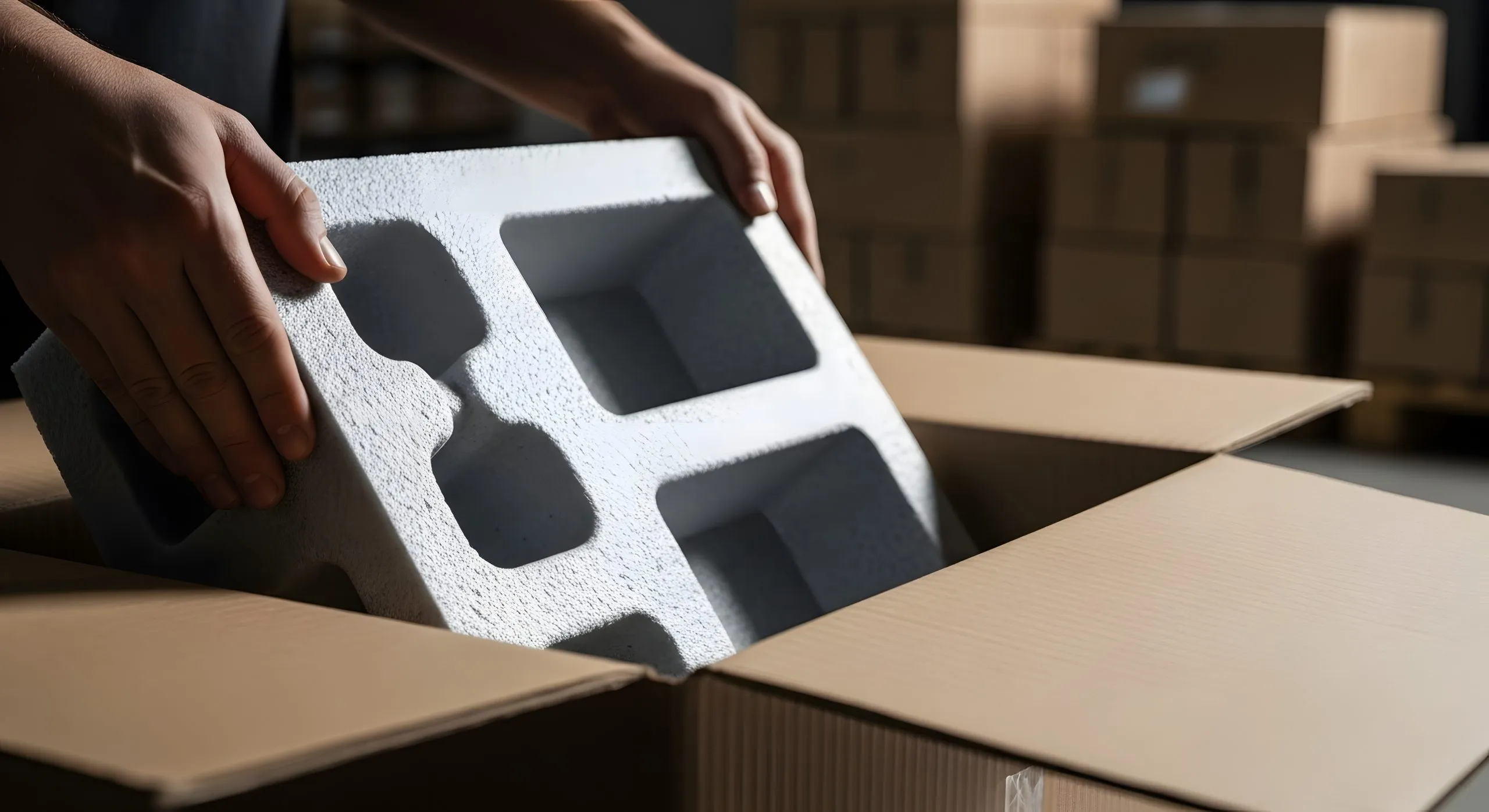
Foam inserts are ideal for high-value, precision, or irregularly shaped products like surgical tools, lenses, circuit boards, or sensors. They are highly customizable and are typically custom-cut to fit snugly around the item.
Foam absorbs both shock and vibration and keeps the item from shifting during transport. Inserts can be layered or contoured to cradle the product securely, making them perfect for international or high-impact shipping.
Choose closed-cell polyethylene foam if you are looking for moisture resistance and extra structural strength.
Best for: Medical instruments, sensitive electronics, expensive components
3. Corrugated Boxes (Double or Triple Wall)
Corrugated boxes are commonly used as the outer packaging for any fragile item. It can be paired with inner cushioning (foam, bubble wrap, etc.) for added protection and is often used to ship ceramics, glassware sets, and electronics.
Double- and triple-wall corrugated boxes provide superior stacking strength and crush resistance, which is critical for palletized freight or heavy fragile goods.
Be sure to look for boxes rated with a high Edge Crush Test (ECT) score or Burst Strength for maximum durability.
Best for: Stacked shipments, large or multiple fragile items
4. Air Pillows
Air pillows are great for filling voids around pre-wrapped fragile items in a shipping box and are often used to stabilize lightweight glass or ceramic products in transit.
Air pillows prevent internal shifting, which can lead to cracks or breaks. They’re ideal when you need lightweight protection that adds minimal shipping weight.
Avoid using air pillows for sharp or oddly shaped fragile items as they can puncture easily.
Best for: Void fill and light cushioning during transit
5. Molded Pulp
Molded pulp is used to hold fragile items like glass bottles, jars, and small electronics in a fixed position during transport and is commonly found in the beverage, cosmetics, and home goods industries.
Molded pulp cradles items securely and can be stacked with low risk of movement. It’s an eco-friendly solution for brands looking to reduce plastic usage while still protecting delicate products.
Ensure any products you are packaging are dry and that the molded pulp is treated for moisture resistance if humidity is a concern.
Best for: Bottles, glass containers, some electronics
6. Expanded Polystyrene (EPS) Foam
EPS foam is commonly used to package large fragile items such as refrigerators, lab equipment, or computer monitors. It can be formed into custom-fit corner blocks or full encasements.
For sensitive components or temperature-controlled goods, EPS provides high-impact resistance and insulation. EPS is often used for LTL (less-than-truckload) freight shipments.
If sustainability is a concern, explore alternative rigid foams or ensure a recycling path for used EPS materials.
Best for: Appliances, laboratory equipment, temperature-sensitive products
7. Custom Crates or Wood Packaging
Custom crates and wood packaging are best suited for fragile heavy items like janitorial equipment, scientific instruments, or delicate tools that require international or long-distance shipping.
Wooden crates offer a rigid barrier against drops, compression, and vibration. Custom interior bracing or foam-lined walls provide additional layered protection.
Best for: Industrial machinery, fragile equipment, international shipping
Key Considerations for Packaging Fragile Items
Let’s take a closer look at what should guide your decision:
1. Cushioning Ability
2. Compression Strength
3. Barrier Protection
4. Material Costs vs. Damage Costs
5. Ease of Use
6. Sustainability
7. Customization
1. Cushioning Ability
The packaging must absorb shocks, drops, and vibration. Bubble wrap, foam inserts, and air pillows are popular choices, but each works best in different scenarios.
2. Compression Strength
How much pressure can the packaging withstand when stacked? Corrugated boxes have different strength grades. If your items are going to be stacked on pallets, this is a critical factor.
3. Barrier Protection
Fragile items may also need protection from moisture, static electricity, or temperature changes. Think electronics, perishable goods, or lab samples.
4. Material Costs vs. Damage Costs
You might be tempted to choose cheaper packaging, but the cost of product damage and returns can outweigh initial savings.
5. Ease of Use
Packaging should be easy to assemble and load, especially if you’re dealing with high volumes. Complicated packaging slows down the fulfillment process.
6. Sustainability
Eco-friendly options like molded pulp are becoming more viable. Consider your company’s sustainability goals.
7. Customization
Custom inserts, branded boxes, and tailored solutions add protection and polish. They’re particularly useful for delicate or irregular-shaped products.
Advanced Tips for Selecting the Right Packaging
Once you’ve narrowed down your basic options, it’s worth exploring some more advanced strategies to fine-tune your packaging approach.
These tactics are used by leading logistics and operations teams to reduce costs, improve efficiency, and enhance product protection, especially for high-value or high-risk fragile items:
1. Run Packaging Performance Tests
2. Evaluate Total Cost of Ownership (TCO)
3. Consider Automation Compatibility
4. Leverage Feedback from Logistics and Returns Teams
1. Run Packaging Performance Tests
Lab-based testing helps predict how your packaging will perform under real-world conditions like vibration, drop impact, and stacking pressure.
What to do:
Use standardized tests from the International Safe Transit Association (ISTA) or ASTM International. Common testing includes:
- Drop tests – simulate accidental drops during handling.
- Vibration tests – simulate vehicle and conveyor vibrations.
- Compression tests – measure how much stacking pressure your packaging can handle.
2. Evaluate Total Cost of Ownership (TCO)
Packaging costs don’t stop at the price per unit. You need to look at the complete picture, especially when dealing with fragile items.
Key cost areas to consider:
- Packaging materials
- Damage/return rates
- Labor required for packing
- Storage footprint
- Customer returns and replacements
- Waste disposal or recycling
Use a spreadsheet or packaging calculator to compare actual performance data across multiple options.
Pro Tip: A foam insert might be more expensive upfront than bubble wrap, but if it reduces your breakage rate by 60%, it’s likely the more cost-effective long-term solution.
3. Consider Automation Compatibility
If your fulfillment operation uses (or plans to use) packaging automation, your packaging must be machine-compatible.
Look for packaging that:
- Works with auto-baggers, box erectors, or foam-in-place systems
Has consistent dimensions and rigidity - Doesn’t require excessive manual assembly
Packaging automation can lead to faster packing speeds, lower labor costs, reduced injury risk, and more consistent packaging quality.
Pro Tip: Imperial Brady offers packaging audits to evaluate your line for automation potential and can recommend automation-friendly packaging upgrades.
4. Leverage Feedback from Logistics and Returns Teams
Your warehouse team and delivery carriers are on the front lines. They see firsthand how fragile items perform during handling and what often gets damaged.
How to gather insights:
- Conduct short surveys with packers and warehouse staff
- Review shipping and returns data to identify trends
- Ask your 3PL or freight partner about common failure points
- Talk to customer service reps about damage complaints
You might discover, for example, that a certain product needs corner protection because it’s routinely damaged during forklift transfers even if it passed your drop tests.
Use these insights to update your standard operating procedures (SOPs) or create product-specific packing guidelines.
Every company’s packaging needs are a little different, especially when it comes to fragile items. The more information you gather about your products, transit environment, customer expectations, and packaging performance, the more confident your packaging decisions will be.
Why the Right Packaging for Fragile Items Matters
When you’re dealing with fragile goods, packaging isn’t just a box; it’s protection, reputation, and cost control all rolled into one.
1. Damage Prevention: Fragile items are more susceptible to drops, vibration, compression, and temperature changes. Without adequate packaging, they can easily arrive broken or defective.
2. Cost Savings: Returns, replacements, and customer dissatisfaction cost time and money. Well-chosen packaging reduces these costs by decreasing breakage rates.
3. Customer Satisfaction: Your packaging is part of your brand. Damaged goods hurt your reputation and may result in poor reviews or lost clients.
4. Regulatory and Industry Standards: Certain industries—such as pharmaceuticals or food processing—require packaging that meets specific safety, hygiene, or labeling standards. The right solution ensures compliance.
5. Sustainability: With increasing pressure to go green, packaging solutions that balance protection with eco-friendliness are gaining importance.
Final Thoughts
Choosing the best industrial packaging for fragile items is part art, part science. The right choice balances protection, cost, sustainability, and customer experience.
Whether you’re shipping fragile electronics across the country or medical devices overseas, investing time in selecting the right packaging can lead to fewer damages, happier customers, and better bottom-line results.
By understanding your product, shipping conditions, and available materials, you’ll be in a strong position to make the best packaging decision for your operation.
Need a custom packaging audit or recommendations for your business? Don’t hesitate to reach out to Imperial Brady! Our packaging experts can assess your unique needs and help tailor a solution that protects both your products and your reputation.
Check Out These Related Articles:
- Shrink Wrap vs. Stretch Wrap: What’s the Difference and When to Use Each
- Stretch Wrap 101: What Is Industrial Plastic Wrap, Types of Plastic Stretch Wrap, & How to Use
- Stretch Wrap 101: How to Save Money with the Right Stretch Wrap Dispenser
- 3 Ways to Reduce Stretch Wrap Costs for your Business
- Automated Packaging: 5 Machines for Your Packaging Facility + How to Implement Them
- Edge Protectors 101: Everything You Need to Know
- Industrial Packaging Tape: Everything You Need to Know
- Void Fill 101: A Guide to Safe Shipping and Transporting Goods


